
Infographics
Europe’s Best Countries to Live and Work (2025-2026)
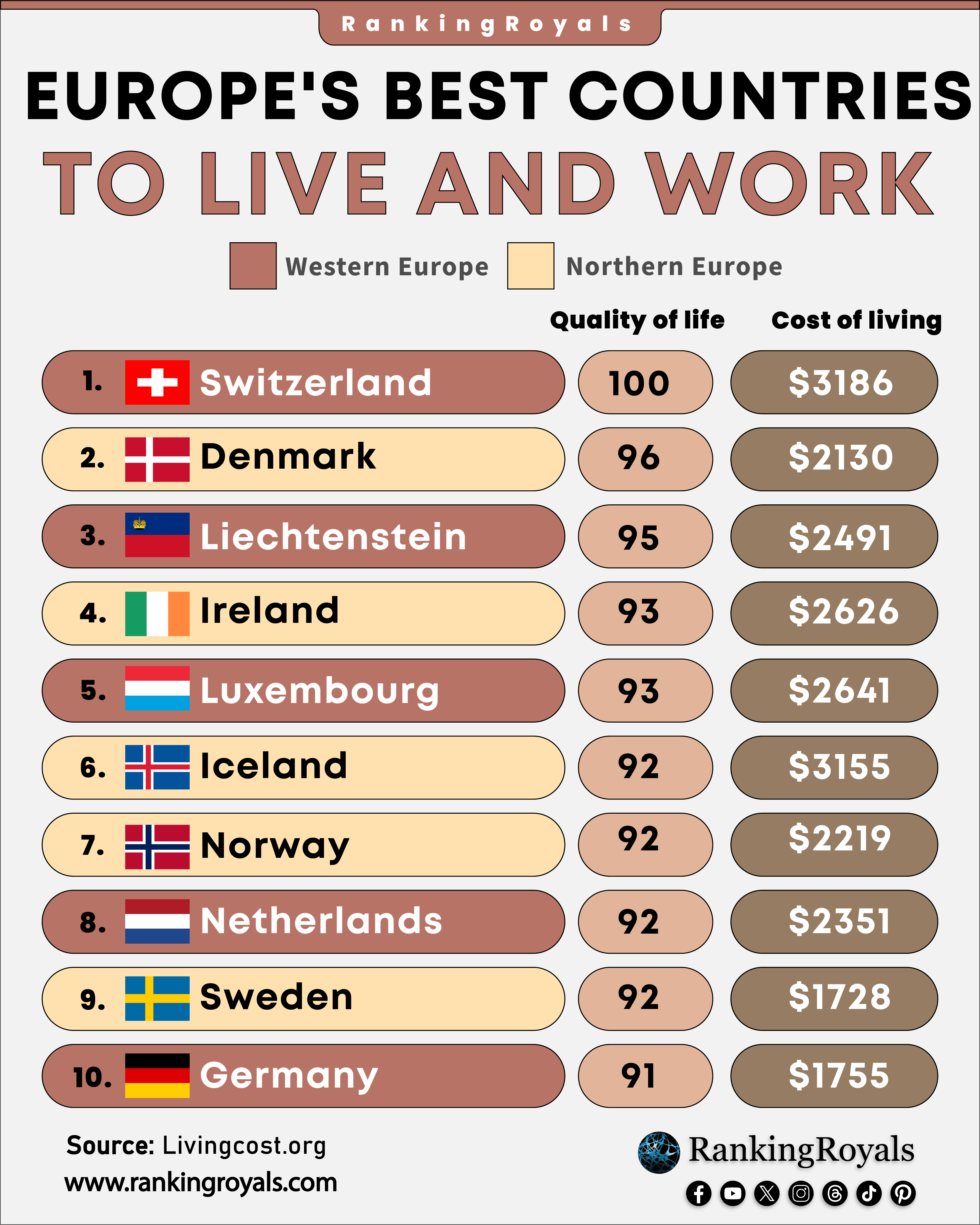
Europe’s top countries for quality of life have great infrastructure, strong social systems, and attract people from all over the world. This guide looks at ten leading countries in the 2026 rankings, sharing clear details about monthly costs, daily life, climate, culture, and what makes each place unique.
Understanding the Rankings
The rankings use both quality-of-life scores covering safety, healthcare, education, infrastructure, and satisfaction, and real monthly living costs such as housing, food, and transport. Switzerland and Luxembourg score highest but are expensive, while Sweden and Germany offer similar quality at much lower prices.
1. SWITZERLAND: The Pinnacle ($3,186/month)
Switzerland offers stunning mountain scenery, stable politics, a strong economy, and top-notch infrastructure. With the Alps covering most of the country and lakes part of daily life, living in Switzerland is more than just a high ranking—it changes your everyday experience.
Why Switzerland Stands Out
In Switzerland, you wake up to mountain views that most people only see on vacation. Kids walk to school on their own from age four, which is rare elsewhere because of safety concerns. Healthcare is easy to use, with quick appointments and no complicated paperwork. The direct democracy system lets citizens vote on laws several times a year, so you really feel your voice matters.
A 42-hour workweek is normal, and people get 4 to 6 weeks of vacation each year. Leaving work on time is expected, not frowned upon. Every big city is close to hiking, skiing, or lakes, and for Swiss residents, this is just everyday life—not just a sales pitch.
Cost of Living Breakdown
Monthly Expenses (Single Person):
- Total: CHF 3,000-3,500 ($3,186-3,720) including rent
- Housing in Zurich/Geneva: CHF 1,500-2,000 ($1,600-2,100) for a 1-bedroom center, CHF 1,000-1,400 ($1,060-1,480) in smaller cities
- Mandatory Health Insurance: CHF 300-500 ($320-530) per person monthly—legally required, no exceptions, deductibles CHF 300-2,500 annually
- Groceries: CHF 600-900 ($640-960)
- Dining Out: CHF 25-35 ($27-37) per casual meal; CHF 50-75 ($53-80) mid-range restaurant
- Public Transport: CHF 70-85 ($74-90) monthly pass connecting remote villages to cities within minutes
- Coffee at Café: CHF 4-5 ($4.25-5.30) for espresso
Swiss salaries are much higher than in nearby countries—usually 30-50% more than similar jobs in France, Germany, or Austria. With a GDP per capita over $99,000, most people have strong buying power. The key issue is not just affording Switzerland, but whether you can earn a Swiss salary.
Regional Variations: Finding Your Switzerland
Most Expensive Tier:
Zurich and Geneva have the highest rents (CHF 1,800-2,200/$1,900-2,330). Zurich is the financial center, home to banks, tech companies, and many international professionals. The city is energetic, with lots of career and networking opportunities. Geneva hosts many international organizations, so about 40% of its population is foreign. English is widely used for work and daily life, and the large expat community makes it easier to settle in compared to German-speaking parts of Switzerland.
Zurich and Geneva have the highest rents (CHF 1,800-2,200/$1,900-2,330). Zurich is the financial center, home to banks, tech companies, and many international professionals. The city is energetic, with lots of career and networking opportunities. Geneva hosts many international organizations, so about 40% of its population is foreign. English is widely used for work and daily life, and the large expat community makes it easier to settle in compared to German-speaking parts of Switzerland.
Mid-Range Cities:
Basel (CHF 1,300-1,700/$1,380-1,800) is Europe’s cultural capital, with museums densely packed throughout the neighborhoods. Pharmaceutical companies (Roche, Novartis) offer an alternative to careers in the banking sector. Bern (CHF 1,300-1,600/$1,380-1,700) is Switzerland’s federal capital, with an UNESCO-protected Old Town, government employment opportunities, and charming medieval architecture that creates daily beauty. Lausanne (CHF 1,400-1,700/$1,480-1,800) sits on Lake Geneva’s northeastern shore, hosting Olympic headquarters and university life.
Basel (CHF 1,300-1,700/$1,380-1,800) is Europe’s cultural capital, with museums densely packed throughout the neighborhoods. Pharmaceutical companies (Roche, Novartis) offer an alternative to careers in the banking sector. Bern (CHF 1,300-1,600/$1,380-1,700) is Switzerland’s federal capital, with an UNESCO-protected Old Town, government employment opportunities, and charming medieval architecture that creates daily beauty. Lausanne (CHF 1,400-1,700/$1,480-1,800) sits on Lake Geneva’s northeastern shore, hosting Olympic headquarters and university life.
Most Affordable (Relatively):
Lucerne (CHF 1,200-1,500/$1,270-1,590) provides stunning lake access with mountains reflecting in the water, a tourism-focused economy, and accessible housing. St. Gallen (CHF 1,000-1,300/$1,060-1,380) in eastern Switzerland offers small-city charm and textile-industry heritage. Rural alpine villages (CHF 800-1,200/$850-1,270) deliver stunning scenery but extremely limited job markets.
Lucerne (CHF 1,200-1,500/$1,270-1,590) provides stunning lake access with mountains reflecting in the water, a tourism-focused economy, and accessible housing. St. Gallen (CHF 1,000-1,300/$1,060-1,380) in eastern Switzerland offers small-city charm and textile-industry heritage. Rural alpine villages (CHF 800-1,200/$850-1,270) deliver stunning scenery but extremely limited job markets.
Ticino’s Hidden Gem:
Southern Ticino is unique in Switzerland for its Mediterranean climate. Lugano, with 63,000 residents, has palm trees along the lake, over 2,300 hours of sunshine each year, and mild winters. The Italian-speaking culture gives it a different feel from the rest of Switzerland. Locarno also has a warm climate, lakeside walks, and art festivals. The downside is a smaller job market focused on banking, tourism, and Italian-Swiss business. Ticino is a good choice if you value climate and lifestyle over career opportunities.
Southern Ticino is unique in Switzerland for its Mediterranean climate. Lugano, with 63,000 residents, has palm trees along the lake, over 2,300 hours of sunshine each year, and mild winters. The Italian-speaking culture gives it a different feel from the rest of Switzerland. Locarno also has a warm climate, lakeside walks, and art festivals. The downside is a smaller job market focused on banking, tourism, and Italian-Swiss business. Ticino is a good choice if you value climate and lifestyle over career opportunities.
Climate & Geography: Four Distinct Worlds
The Swiss Plateau, which includes Zurich, Bern, Basel, and Lucerne, has a temperate climate. Winters are cold, from -2°C to 4°C (28-39°F), and summers are warm, from 18-28°C (64-82°F), with moderate rain all year. Spring brings wildflowers, and autumn has colorful leaves and harvest festivals.
The Alpine regions, such as Zermatt, Davos, St. Moritz, and Interlaken, receive heavy snowfall (2-4 meters per year) and experience months of freezing temperatures. Skiing is a big part of life from October to May. The mountains shape daily life, with amazing views, hiking trails between villages, and nature all around.
Ticino in southern Switzerland transforms completely into a Mediterranean microclimate with over 2,300 annual sunshine hours, mild winters rarely below 0°C (32°F), palm trees adorning public squares, Italian architectural traditions (colorful buildings, outdoor cafés, siesta culture), and social dynamics noticeably warmer than reserved Germanic Switzerland.
The Geneva Lake region benefits from maritime influences that moderate temperatures, though the infamous Bise wind (a cold northeasterly) makes winters feel significantly colder than thermometers suggest.
Food & Culture: Multilingual Culinary Heritage
Swiss cuisine brilliantly reflects its geographic and cultural crossroads. German-speaking regions (62% of the population) bring hearty sausages, rösti (crispy shredded potato pancakes fried until golden), and substantial meat-based dishes. French-speaking regions (23%) provide the elegant tradition of fondue and raclette—melted cheese scraped over boiled potatoes, pickles, and cured meats, eaten communally around fondue pots in cozy alpine chalets. Italian-speaking Ticino offers risottos, polentas, and Mediterranean vegetables, defining northern Italian cuisine.
National specialties include Zürcher Geschnetzeltes (veal in cream sauce with mushrooms), countless distinctive cheeses (Gruyère’s nutty complexity, Emmental’s sweet holes, Appenzeller’s regional mystique), and world-famous Swiss chocolate from Lindt, Toblerone, and countless smaller artisanal producers.
Swiss culture values privacy and people tend to be reserved, so making friends can take time. Being on time is important—arriving even five minutes late calls for a real apology. There are strict noise rules, like no vacuuming after 10pm, to keep things peaceful. Citizens vote on laws several times a year, so everyone has a say. The country is multilingual: 62% speak German, 23% French, 8% Italian, 0.5% Romansh, and English is common in business.
Lifestyle by Major Cities
Zurich (420,000) functions as a financial capital where gleaming towers house banking headquarters and tech operations. The city’s energy is palpable—ambitious professionals, constant deal-making, and networking density unusual even by Swiss standards. Lake Zurich provides a recreational counterbalance to high-pressure careers. Quality of life ranks 196.6 out of 218.2 maximum, reflecting excellent infrastructure offset by job intensity. Neighborhoods like Wiedikon attract creative communities; Kreis 5 appeals to younger professionals; Riesbach provides upscale family living.
Geneva (200,000) hosts international organizations (UN, WHO, Red Cross, International Court of Justice), creating 40% foreign population and a genuinely international atmosphere. Speaking only English is feasible here—something nearly impossible in German-speaking Swiss cities. The international organization culture creates expatriate communities already established, making newcomer integration smoother. English schools, international clubs, and expatriate networks all thrive. Personality differs from Zurich: less finance-driven intensity, more diplomatic reserve, slower-paced despite significant international business activity.
Basel (175,000) earns a reputation as Europe’s cultural capital with a museum density exceeding cities triple its size. Pharmaceutical companies (Roche, Novartis) provide career alternative to banking. The Rhine River enables unusual commute option—some locals float down river from home to office using currents, jumping out at workplace. Medieval architecture surrounds modern innovation centers, creating thoughtful urban planning prioritizing heritage alongside progress.
Lugano (63,000) in Ticino transforms Swiss living into something resembling northern Italy. Palm-lined lakefront promenades, Italian language everywhere, Mediterranean ambiance, relaxed lifestyle with later dining hours (dinner at 8-9pm rather than 6:30), siesta culture, expressive social dynamics contrasting sharply with reserved Germanic Switzerland. The trade-off is real: job market concentrates in banking, tourism, and Italian-Swiss business—career options shrink substantially but lifestyle quality dramatically increases.
Q1: What salary do I realistically need to live comfortably in Switzerland?
If you’re single, aim for a salary of CHF 80,000-100,000 ($85,000-105,000) a year to live comfortably in a big city. Families need CHF 130,000-160,000 ($138,000-170,000), depending on the city and number of children. The good news is that Swiss salaries usually meet or exceed these amounts. Median wages are much higher than in most of Europe, so you can live well on a Swiss income.
Purchasing power is high in Switzerland because salaries and prices both go up together. For example, coffee costs CHF 4-5 ($4.25-5.30) instead of $2, but people also earn more. With a Purchasing Power Index of 183.5 (third in the world), Swiss residents can buy more with their income than almost anywhere else.
The main challenge is for people early in their careers, retirees, spouses who don’t work, and single-income families. If you’re mid-career and earning a Swiss salary, living in Switzerland is much easier. If you’re earning income from another country, it can be tough to afford life here.
Q2: Which Swiss city suits English-speaking expats best?
Geneva dominates without contest. The 40% foreign-born population creates expatriate infrastructure impossible elsewhere. International organizations running on English, established expat communities spanning multiple nationalities, international schools, English-language events and social clubs, multilingual professionals—all remove friction from settling. Zurich ranks second with international business community and English-language schools, though German becomes increasingly important beyond work. Basel requires more German daily. Avoid smaller towns and rural German-speaking areas unless planning to invest in language learning—these expect linguistic conformity challenging non-German speakers.
To be honest, Geneva is truly different. While most Swiss cities expect you to learn the local language, Geneva makes it possible to live and work using only English. This isn’t the case in German or Italian-speaking regions.
Q3: Should I choose Ticino over German Switzerland if climate matters to me?
Yes, especially if weather affects your mood or health. Ticino looks Swiss but feels Italian, with palm trees, warm breezes, and over 2,300 hours of sunshine each year—much sunnier than German-speaking Switzerland. It’s like living in northern Italy but with Swiss efficiency and safety. The lifestyle is also different: people eat dinner later, enjoy siestas, spend time in outdoor cafés, and the culture is warmer and more relaxed.
However, there’s a big trade-off. The job market in Ticino is much smaller, mostly focused on banking, tourism, and hospitality. It’s best for people who already have established careers or can work remotely and want a better quality of life. If career growth is your priority, German-speaking Switzerland has more opportunities, even if the weather isn’t as nice.
2. DENMARK: The Family Paradise ($2,320/month)
Denmark represents something genuinely rare: a nation that has collectively decided that families shouldn’t stress about childcare costs, education funding, or the risk of healthcare bankruptcy. With universal healthcare, free education from daycare through PhD, and subsidized childcare consuming just 25% of operating costs (often zero for lower-income families), Denmark removes financial anxieties that plague parents elsewhere.
The concept of hygge, an untranslatable Danish term describing cozy contentment and togetherness, permeates daily life. It manifests through candlelit dinners in homes (Danes consume Europe’s largest candles per capita, deliberate, not accident), extended conversations emphasizing quality over efficiency, prioritizing meaningful relationships over material accumulation. This cultural philosophy provides a psychological foundation for the world happiness rankings where Denmark consistently ranks top-three.
Why Denmark Works for Families
The childcare revolution changes everything. Private childcare costs parents $15,000-25,000 annually in the US/UK; Danish families pay DKK 3,000-4,500 ($410-620) monthly maximum, with lower-income households paying nothing through means-testing. Multiply by two children, add tuition costs ($15,000-40,000 per child yearly for private school, $30,000-70,000 yearly for universities), and American families accumulate $300,000-500,000+ in education and childcare costs over childhood. Denmark provides identical outcomes completely free.
Parental leave spans 320 working days per child, split between both parents, enabling genuine time with infants without financial devastation. Healthcare is universal—pediatric care, emergency rooms, specialist visits, prescriptions all covered. Employment laws protect part-time workers, enabling parents to reduce hours (32-hour workweeks are normal, not career-ending) and maintain income while prioritizing children.
The result: parents focus on raising children rather than constantly calculating costs. Psychological freedom created by financial security enables parenting that prioritizes emotional development over financial stress management.
Cost of Living Analysis
Monthly Budget (Verified 2026):
- Single Person: €2,140 ($2,320) including rent OR DKK 15,500
- Family of Four: €5,855 ($6,350) or DKK 43,000 including rent
- Average Salary: DKK 50,000 ($6,900/month)—271% more than single person’s living costs
Regional Cost Breakdown:
Copenhagen (630,000) commands capital premium: DKK 18,500-22,000 ($2,550-3,000) monthly including rent. Housing intensely competitive—apartments receive dozens of applications within hours, landlords prefer Danish nationals, desirable neighborhoods like Indre By, Østerbro, Frederiksberg generate bidding wars. However, rent is regulated and transparent (the sticker price is the actual cost, not negotiable), tenant-favoring laws provide stability once secured, and housing quality remains high even at premium prices.
Aarhus (285,000) emerges as appealing alternative: DKK 16,500 ($2,285) monthly, 15-20% cheaper than Copenhagen. Denmark’s second city offers a vibrant university atmosphere (Aarhus University dominates), an excellent music scene and cultural events, ARoS art museum with its famous “Your Rainbow Panorama” walkway offering stunning city vistas, Den Gamle By open-air museum, and genuine coastal culture. Young professional demographic creates energy Copenhagen has lost to internationalization and tourism.
Odense (180,000) provides most affordable major city: DKK 15,300 ($2,110) monthly. Hans Christian Andersen’s birthplace carries fairy-tale aesthetic through preserved architecture and museums. Family-friendly infrastructure excels—excellent schools, abundant parks, playgrounds, cultural institutions designed for children. Smaller job market exists but government employment, healthcare, education, tourism provide reasonable opportunities. Slower pace and lower costs attract families over ambitious careerists.
Aalborg (125,000) in northern Denmark offers DKK 15,000-15,500 ($2,070-2,145) monthly. University city with younger demographic, growing tech sector, lower costs, and smaller-town charm without rural isolation.
Detailed Expense Breakdown (Copenhagen, Single Person):
- Rent (1-bed): DKK 9,000-11,000 ($1,230-1,510)
- Utilities (electricity, water, internet): DKK 700-900 ($95-123)
- Groceries: DKK 1,800-2,500 ($246-342)
- Dining out (casual): DKK 100-150 ($14-20) per meal
- Mid-range restaurant (two people): DKK 600-800 ($82-109)
- Public transport pass: DKK 600-900 ($82-123) monthly
- Health insurance: Included in taxes
- Coffee at café: DKK 25-35 ($3.40-4.80)
Climate & Geography: The Gray Comfort
Denmark experiences temperate oceanic climate—mild but persistently gray. Winters rarely drop below -5°C (23°F), avoiding brutal continental cold, but overcast dampness dominates with just 7-8 hours daylight December-January. Summers bring cool to mild temperatures (15-22°C/59-72°F) without oppressive heat, though frequent rain showers interrupt outdoor plans. Annual rainfall of 600-800mm spreads throughout year, creating “gray skies” as Danes’ most common complaint about their own country.
Geography consists of flat windswept peninsulas and islands with 7,314 km coastline—beaches are within 50 km of anywhere. Best months (May-August) provide longest daylight, mildest temperatures, and outdoor festivals transforming cities. The summer light lasts past 10pm, extending evening outdoor activities, compensating for winter darkness with nearly perpetual daytime brightness.
Food & Culture: New Nordic Tradition Meets Comfort
Smørrebrød (open-faced sandwiches on dense dark rye bread) forms national lunch culture—topped with herring, salmon, roast beef, eggs, elaborate combinations creating art on bread. These aren’t casual lunches but cultural statements about ingredient quality and presentation standards.
Frikadeller (Danish pan-fried meatballs served with lingonberry jam), flæskesteg (roast pork with crackling skin achieving near-religious status during holidays), rød pølse (distinctive red hot dogs from street carts topped with onions, pickles, mustard, ketchup, remoulade) represent everyday eating.
But Denmark balances this traditional comfort food with avant-garde innovation. Noma (three Michelin stars, “World’s Best Restaurant” five times) and Geranium (three Michelin stars) elevated Danish food through ultra-local seasonal foraged ingredients—creating dual identity where Danes simultaneously value both grandmother’s beloved recipes and cutting-edge molecular gastronomy.
Hygge culture permeates daily life beyond food. It manifests through candlelit dinners where Danish homes glow softly from countless candles, comfortable home environments emphasized over impressive décor, quality time with loved ones valued over productivity, simple pleasures celebrated. The concept emerged naturally from necessity (coping with long dark winters through coziness) but has become core Danish identity. Declining hygge invitations—whether dinner parties or café conversations—signals social rejection.
Work culture differs dramatically from US/UK models. Flat hierarchies mean junior employees comfortably question senior management without hierarchy toxicity. Consensus-building seems inefficient to outsiders but reflects genuine democratic values. The sacred 37-40 hour workweek is non-negotiable—leaving at 16:30 is standard, checking work emails evenings/weekends is discouraged, minimum 5-week vacation must be used. This isn’t aspirational marketing; it’s enforced cultural norm. Colleagues actually question those not using entitled vacation time.
Lifestyle & Major Cities
Copenhagen dominates as progressive bicycle capital where 62% of residents bike daily, supported by 385 km of dedicated cycle tracks. Tivoli Gardens provides traditional amusement park charm; Nyhavn harbor with colorful buildings reflects in water creating Instagram perfection; street food markets showcase Scandinavian cuisine evolution. The city attracts 13% foreign-born population, speaks English widely, offers international schools and expat communities. Challenges include highest costs, intense housing competition (months-long searches), rising tourist crowds transforming neighborhoods, occasional petty theft in central districts.
Aarhus feels like Copenhagen’s cooler younger sibling—less touristy, more authentic, vibrant university atmosphere creating cultural energy. ARoS art museum revolutionized how cities think about public art; Den Gamle By open-air museum preserves historic Danish life; coastal location provides beach recreation; restaurant scene increasingly rivals Copenhagen; nightlife and music venues thrive; housing significantly easier to secure.
Odense attracts families more than ambitious professionals. Hans Christian Andersen’s birthplace carries fairy-tale aesthetic genuine and charming rather than commercialized. School quality is exceptional; parks and green spaces abundant; pace slower enabling deeper community connections. If you’re willing to sacrifice capital city career opportunities for lower costs and family-friendly infrastructure, Odense delivers.
Q1: How do families actually afford expensive Denmark when salaries are only moderately higher than living costs?
This question reveals common misconception. Yes, average salary (DKK 50,000/$6,900 monthly) only exceeds single person costs (€2,140/$2,320) by 271%. The math looks tight until you factor in what families DON’T pay.
Childcare with private providers costs $15,000-25,000 yearly in US/UK; Denmark charges DKK 3,000-4,500 ($410-620) monthly maximum, often reducing to zero through means-testing. All public education from primary through university PhD is completely free—no tuition ever. Private childcare plus private school plus university tuition totals $300,000-500,000+ over childhood in most developed nations.
Add generous parental leave (320 days per child), free healthcare including pediatric care, subsidized after-school programs, and subsidized elder care if needed. Danish families literally save hundreds of thousands compared to peers in US/UK while working identical hours.
The hidden value isn’t visible in monthly budgets—it’s visible only when calculating lifetime family costs. Denmark becomes exceptionally affordable for families despite high nominal prices. Single adults without children actually pay premium with no offsetting benefits.
Q2: Can I function with only English, or is Danish learning essential?
Short answer: Copenhagen and major cities enable English-only functioning. 90%+ urban residents speak English fluently, international companies operate in English, major retailers accommodate, social services provide English support. Longer answer: official documents (employment contracts, rental agreements, insurance, government correspondence) arrive in Danish, requiring translation services. Career advancement hits ceilings without Danish—local companies expect Danish for client-facing roles and management positions. Permanent residence requires passing Prøve i Dansk 3 (intermediate test) after 8 years.
Most successful expats achieve conversational Danish within 18-24 months through SFI (free Swedish for Immigrants courses—yes, the irony). Investment pays dividends: Danish friends beyond surface-level work relationships, cultural understanding enabling genuine integration, broader job access, reduced daily friction negotiating Danish bureaucracy.
Q3: How severe are Denmark’s dark winters really, and can you adapt?
December-January daylight lasts just 7-8 hours (sun rising 8:30am, setting 3:45pm) combined with frequent overcast skies obscuring even limited sunlight. Vitamin D deficiency affects most without supplementation; seasonal affective disorder runs common enough that light therapy lamps are doctor-recommended. Psychological impact of months with minimal sunlight shouldn’t be underestimated, particularly for sun-climate relocators.
Danes cope through deliberate strategies: hygge culture (cozy environments, abundant candles), active outdoor lifestyle regardless of weather (Danes bike in rain/snow/darkness routinely), robust social engagement (dinner parties, cultural events, community activities), universal vitamin D supplementation. First winter shocks newcomers—darkness feels oppressive. Most adapt by second/third winter through embracing rather than resisting. The psychological adjustment isn’t instant but achievable.
May-August compensation matters: endless daylight (sunset past 10pm), vibrant outdoor culture, festivals transforming cities. Many who survive first winter report that summer brightness creates powerful appreciation and energy otherwise impossible to access.
3. LIECHTENSTEIN: The Fairytale Micro-Nation ($2,491/month)
Nestled between Switzerland and Austria in just 160 square kilometers (62 square miles), Liechtenstein offers exclusive alpine living combining Swiss efficiency with Austrian charm. This double-landlocked principality—surrounded entirely by landlocked nations (one of only two globally, the other being Uzbekistan)—creates something genuinely unique: a country so small you can drive end-to-end in under an hour, yet offering world-class infrastructure, exceptional safety, and billionaires’ privacy alongside working-class charm.
With just 38,000 residents, Liechtenstein achieves what larger nations cannot: true community where the ruling Prince invites the entire population to annual castle party, poverty rate drops to literally zero, and everyone genuinely knows their neighbors.
What Makes Liechtenstein Different
Living here means accessing Swiss-level quality without Swiss-level taxation. The constitutional monarchy uses Swiss Franc currency and maintains border-free access to Switzerland, yet keeps corporate and personal tax burdens substantially lower than Swiss counterparts. This attracts high-net-worth individuals seeking wealth preservation, financial privacy, and elite community.
But the real magic isn’t financial—it’s cultural. Staatsfeiertag (August 15 national holiday) transforms the entire country into celebration when Prince Hans-Adam II and Prince Alois personally invite all 39,000 residents to Vaduz Castle for speeches, government-funded beer-and-wine reception, fireworks, and communal celebration. This probably doesn’t occur in any other country globally—a ruler throwing annual party for entire population. Fasnacht (February carnival) sees residents wearing traditional wooden masks with long fake beards, costumes (milk cows, frog princes, bread loaves), filling streets with music, mulled wine, pastries, street parties extending late. Despite 40,000 population, festivals feel like 400,000 participating.
Cost of Living Analysis
Monthly Budget:
- Total: $2,491-2,800 (CHF 2,350-2,650)
- Housing: CHF 1,500-2,500 ($1,600-2,650) for 1-bedroom apartment
- Cost Ratio: 156% of European average (56% higher than France)
- Food: CHF 800-1,200 ($850-1,280) monthly per person
- Healthcare: Mandatory Swiss-style system, CHF 250-450 ($265-475) monthly
- Transportation: No public transport system—car ownership necessary; gasoline CHF 1.60-1.80/liter ($6.80-7.65/gallon)
- Average Salary: CHF 7,000+ ($7,425) monthly with many professionals earning CHF 10,000-15,000 ($10,600-15,900)
Regional Character:
Vaduz (5,425 residents, capital) functions as cultural and artistic center. Streets are tidy and peaceful lined with trams, bicycles, luxury cars. Castle dominates hilltop. Most expensive housing (CHF 2,200-2,800/$2,330-2,970 for 1-bed). Administrative, banking, government jobs concentrate here. International atmosphere despite small size with significant expat professional communities working in finance and government.
Triesenberg emerges as fairytale village appearing to drift in clouds—mist gently blankets traditional steep-roofed wooden houses, creating “most beautiful cloud village in Liechtenstein.” Home to Walser people (community migrated 13th century), preserving distinctive dialect, customs, traditional architecture. Walser Museum transports visitors to historic life with costumes, tools, models. Housing more affordable (CHF 1,400-1,900/$1,480-2,015) but limited job access.
Schaan (6,000 residents) emerges as largest municipality, industrial center, more affordable than Vaduz, family-friendly with schools and services.
Climate & Food & Culture: Coffee Time Ritual
Alpine climate with four distinct seasons: cold snowy winters (-2°C to 5°C/28-41°F) with skiing access; warm summers (18-26°C/64-79°F) perfect for hiking. Mountains define landscape—spectacular vistas form daily reality.
Hafababa (hearty dumpling soup from humble rural roots), Riyel (crunchy roasted grain dish served with fruit jam or cold cuts for breakfast), traditional dense Alpine-style bread with rye and wheat, cheese production (alpine varieties), cured meats, apple-based desserts reflect agricultural heritage.
The most revealing cultural ritual is Coffee Time (3-4pm), sacred social institution full of meaning. Liechtensteiners aren’t hurried; coffee comes with apple pie, jam rolls, homemade chestnut pastries, never plastic lids. One cup suffices—it’s ritual not consumption. Many families use traditional porcelain coffee sets passed through three generations. Hot cup, traditionally baked cake, chat about weather/neighbors/local news maintains social connections. Youth call it “social detox time” when people close laptops, turn off phones, engage in real conversations. Some old village homes still brew coffee with egg yolks, creating rich creamy flavor unknown elsewhere.
Lifestyle Characteristics
Liechtenstein provides stunning alpine scenery, exceptional safety (virtually zero crime), high standard of living. Modern apartments feature contemporary appliances, ample storage, balconies with mountain views. Nature accessibility enables outdoor lifestyle year-round.
Challenges are significant: Small size means limited cultural offerings and entertainment options compared to larger nations—residents frequently travel to Switzerland, Austria, Germany for dining variety, shopping beyond necessities, cultural activities. German language skills essential for any integration (many locals don’t speak English). Tight real estate market makes finding housing competitive. Integration difficult in 38,000-person community where “everyone knows everyone”—if integration falters socially, you cannot escape into anonymity.
Most successful Liechtenstein residents are either wealthy remote workers/business owners (not requiring employment) or corporate professionals on temporary assignments (2-5 years) accepting limited social integration as temporary trade-off for career advancement and tax advantages.
Q1: What’s Liechtenstein’s real advantage over Switzerland?
Lower taxes combined with comparable Swiss quality. While using Swiss Franc currency and matching Swiss quality of life (safety, infrastructure, nature access), Liechtenstein offers significantly lower tax burden attracting high-net-worth individuals and international companies. Corporate tax rates rank among Europe’s lowest; personal income taxes remain moderate. You essentially get Swiss-level quality without Swiss-level taxation.
Additionally, the small community creates unique social cohesion impossible in larger nations—national holiday where entire population celebrates together at Prince’s castle, community events where you see same faces repeatedly, mutual familiarity replacing anonymity. This appeals to specific demographic (wealthy, privacy-conscious, security-seeking) but alienates those requiring urban anonymity or large social pools.
Q2: What’s daily life actually like in country with 38,000 people?
Intimate and community-focused. Vaduz capital (5,425 people) feels more like charming town than metropolis. Streets are quiet, everyone recognizes familiar faces, social connections develop through repeated interactions (coffee time ritual, local events, seasonal festivals). Entire country is driveable in under an hour. For entertainment beyond what small population provides, people travel to Zurich (1.5 hours), Innsbruck (1.5 hours), St. Gallen (45 minutes).
This lifestyle suits specific personality type: those seeking peace, safety, mountain living, and privacy while willing to sacrifice entertainment variety, dining options beyond basics, cultural events, or spontaneous socializing. Others experience it as isolating—dependent on frequent travel to neighboring countries for variety, personal relationships becoming repetitive due to small social pool.
Q3: Is German absolutely required for integration?
Yes, for meaningful daily life and genuine community participation. While Vaduz shops serving international business clients accommodate English, official documents, community interactions, social conversations, local news, cultural participation happen entirely in German. English-only speakers survive but remain isolated from genuine community participation. Many expatriate employees function 2-5 years speaking only English at work and English within expat circles, but report feeling perpetually outside local community.
Those relocating seriously should commit to intensive German learning before arrival or immediately upon arrival. The investment pays dividends: local friendships become possible, cultural understanding deepens, daily friction decreases, and community participation becomes accessible.
4. IRELAND: The Tech Hub with Housing Crisis ($2,626/month)
Ireland combines English-speaking accessibility, vibrant cultural heritage, and thriving technology sector with severe housing shortage creating cost-of-living pressures that challenge quality of life across all income levels. As European headquarters for Apple, Google, Facebook, Microsoft, LinkedIn, Twitter, and Amazon, Ireland offers exceptional career opportunities particularly in technology, finance, and pharmaceuticals. Yet chronic housing supply shortage and escalating rents create affordability crisis affecting professionals earning six figures alongside entry-level workers.
Why Ireland Attracts & Frustrates Simultaneously
The draw is obvious: English language eliminates immigration friction, tech opportunities rival Silicon Valley for international talent, EU membership provides continental freedom, Irish culture emphasizes relationship-building and social connection unlike transactional finance-sector atmospheres elsewhere. The authentic Irish pub culture—live traditional music, genuine conversation, community—appeals to those seeking human connection alongside career.
The frustration emerges immediately: housing searches become psychological torture (40-50% of take-home pay consumed by rent), entire neighborhoods gentrify within years due to tech money influx, homelessness becomes visible daily in city centers, traffic congestion worsens year-over-year, and the housing crisis increasingly feels unsustainable rather than temporary blip.
Cost of Living & Housing Reality
Monthly Budget:
- Dublin: €2,900-3,500 ($3,145-3,795) including rent
- Dublin Rent (1-bed): €2,540 ($2,755)—up 5.8% year-over-year
- Dublin House Purchase: €700,000 ($759,000) average
- Cork Rent: €2,213 ($2,400)—up 13.6% year-over-year
- Galway Rent: €1,200-1,470 ($1,300-1,595)
- Limerick Rent: €2,405 ($2,610)—up 20.4% (highest increase in Ireland)
- Rural Areas: €1,645 ($1,785) average rent
Housing Crisis Reality: 40-50% of take-home pay consumed by rent for many professionals. Tech professionals earning €60,000-80,000 ($65,050-86,750) gross annually take home approximately €3,800-4,800 ($4,120-5,205) monthly. With average Dublin 1-bedroom rent at €2,540 ($2,755), housing alone consumes 53-67% of take-home pay before utilities, groceries, transport, insurance—well above the recommended 30% maximum.
Chronic supply shortage stems from multiple failures: planning constraints limiting development, construction costs deterring builders, years of underbuilding following 2008 crash, foreign investment buying properties for rentals, Airbnb removing housing stock from long-term rental market. Government initiatives promised affordable housing schemes consistently miss targets; planning delays extend development timelines; new construction concentrates in luxury segment rather than middle-income housing. The crisis affects all income levels: professionals with €60,000+ salaries struggle to save while paying premium rents, young couples delay family formation due to housing costs, lower-income workers face impossible situations.
Improvement timeline is pessimistic—even optimistic projections show 5-10 years before supply meets demand, assuming construction accelerates substantially (not currently happening).
Regional Cost Breakdown
Dublin (1.4 million metro) functions as capital and economic center where Georgian architecture meets modern glass towers. Tech hub status creates “Silicon Docks” district along River Liffey hosting Apple headquarters, Google, Facebook, Microsoft European operations. Cultural attractions include Trinity College with Book of Kells, Temple Bar entertainment district, Guinness Storehouse, numerous theaters and music venues.
Challenges: Severe housing crisis with apartments receiving 50+ applications within days, traffic congestion worsening, rising crime in some areas, homelessness visible throughout city center. Neighborhoods like Ballsbridge attract upscale residents, Ranelagh provides young professional atmosphere, Smithfield offers regenerated urban living, Docklands hosts tech workers with modern apartments and high costs.
Cork (210,000) emerges as “rebel county” second city with distinct identity and rivalry with Dublin. English Market (historic covered market from 1788) showcases local produce, artisan foods, seafood—cultural and culinary heart. Pharmaceutical hub with major employers (Pfizer, Johnson & Johnson, Eli Lilly) creating biotech ecosystem. University College Cork creates student energy and academic atmosphere. More relaxed pace than Dublin, distinct local accent difficult even for Irish from other regions, strong local pride, growing cultural scene. However, housing rapidly becomes unaffordable—13.6% annual rent increases threaten middle-class access.
Galway (80,000) functions as cultural capital on western coast known for arts, festivals, bohemian character. Galway International Arts Festival (July), Film Fleadh, Oyster Festival create year-round cultural programming. NUI Galway creates young demographic and vibrant nightlife. Numerous pubs host nightly traditional Irish music sessions (trad sessions) maintaining authentic culture. Gateway to stunning west coast—Connemara mountains, Aran Islands, Cliffs of Moher provide natural beauty minutes away.
Challenges: Small city size creates intense housing competition with limited availability; limited job market outside university/tourism/services; lacking robust public transport to suburbs constraining options. Despite lower nominal costs, small population means housing actually competes intensely despite fewer total residents.
Limerick (95,000) experiences renaissance after decades of economic challenges. University of Limerick creates education and research opportunities. Historic King John’s Castle area and riverside regenerated attracting investment. However, rent inflation runs highest in Ireland (20.4% annually), rapidly eroding affordability advantage.
Climate & Geography: “Four Seasons in One Day”
Ireland’s phrase “four seasons in one day” captures weather unpredictability—sunshine, rain, wind, clouds cycling within hours. Winters are mild (4-8°C) rarely experiencing harsh frost due to Gulf Stream influence, but dampness and wind create raw cold penetrating layers. Summers are cool (15-20°C), occasionally reaching 25°C, without oppressive heat but rarely warm enough for comfortable outdoor swimming.
Rain falls 150-225 days annually depending on location, with western coast (Galway, Clare, Kerry) receiving significantly more than eastern regions (Dublin). “Soft days” (constant light drizzle) define Irish weather experience. Landscape features “forty shades of green” (genuinely—high rainfall creates lush vegetation), dramatic coastal cliffs (Cliffs of Moher, Giant’s Causeway), rolling hills, historic castles dotting countryside. Best months (May-September) provide longest daylight, mildest temperatures, outdoor festivals.
Food & Culture: Pubs as Social Centers
Irish stew (lamb or mutton with potatoes, onions, carrots simmered for hours) represents national dish—warming, filling, simple preparation showcasing ingredient quality. Boxty (potato pancakes) appear throughout Ireland in various forms. Colcannon (mashed potatoes with cabbage or kale) provides traditional accompaniment. Soda bread (made with buttermilk and baking soda) defines Irish baking. Full Irish Breakfast (bacon, sausages, eggs, black pudding, white pudding, baked beans, grilled tomatoes, mushrooms, soda bread) fuels rainy days. Seafood thrives on island nation—fresh oysters, mussels, salmon, cod, famous Dublin Bay prawns.
Pub culture functions as community centers rather than bars. Traditional pubs host trad sessions where musicians gather informally to play together—fiddles, tin whistles, bodhráns, accordions creating musical tapestry. Pub culture emphasizes conversation and “craic” (untranslatable—fun, entertainment, enjoyable conversation, good times). Buying rounds is social obligation—when someone buys you drink, you’re expected to reciprocate eventually. This creates informal credit system strengthening relationships and obligations within communities.
Storytelling tradition sees Irish excel at narrative—conversations weave stories with embellishments, humor, dramatic pauses creating entertainment from everyday events. Self-deprecating humor and relationship focus define business culture. Rushing directly to business agenda without personal relationship-building is considered rude. Trust precedes transactions.
Lifestyle & Major Cities
Dublin attracts 40,000+ tech professionals annually, creating neighborhoods dominated by international expat communities where English suffices, startup energy runs high, networking opportunities constant. However, housing crisis means many work in Dublin while living in suburbs (Bray, Skerries, Maynooth) with 45-minute commutes. Alternatively, corporate housing or house-sharing enables Dublin living.
Cork appeals to mid-career professionals established enough to relocate from Dublin, those seeking second-city charm, pharmaceutical industry workers. More achievable housing compared to Dublin though gap closing rapidly.
Galway attracts lifestyle-focused individuals willing to sacrifice career advancement for cultural richness, outdoor access, smaller-city living. University atmosphere creates youthful energy; traditional music maintains authentic culture; small enough for genuine community yet vibrant enough for cultural engagement.
Q1: Can I actually afford Dublin on a tech salary, and how do people manage housing?
If employed by major tech company earning €60,000-80,000 ($65,050-86,750) gross, yes—but housing will consume disproportionate income. With €2,540 ($2,755) average rent plus utilities, groceries, transport, insurance, you’re spending 50-70% of take-home on housing and basic living before discretionary spending.
Successful strategies people employ: (1) House-sharing: Renting room in shared apartment reduces costs to €800-1,200 ($867-1,300) monthly, creating manageable budget while meeting people; (2) Suburbs with commuter rail: Areas like Maynooth, Bray, Skerries offer €1,400-1,800 ($1,520-1,950) for 1-beds with 30-45 minute train commutes to Dublin; (3) Employer housing assistance: Some tech companies provide relocation support, temporary housing, or stipends for first 3-6 months; (4) Building equity quickly: Despite high nominal costs, if salary is €70,000+, you can save for house deposit within 3-5 years if living frugally, then mortgage payments may equal or undercut rent.
The housing crisis is genuine and frustrating, but manageable for tech professionals willing to compromise on location, apartment size, or house-share initially. Those earning below €50,000 ($54,210) face genuine hardship in Dublin—consider Cork, Limerick, or remote work from rural areas.
Q2: Are Cork, Galway, or Limerick good Dublin alternatives?
Cork: Best Dublin alternative for career opportunities—pharmaceutical/biotech hub with quality employers, established expat community, cultural richness (English Market, festivals), more affordable but gap closing rapidly (13.6% annual rent increases). Choose Cork if you work in pharma/biotech, want second-city amenities, prefer relaxed pace while maintaining career options. 2.5-hour train enables occasional Dublin visits.
Galway: Cultural capital ideal for those prioritizing lifestyle over career advancement—arts festivals, traditional music, bohemian character, university atmosphere, gateway to stunning western landscapes. However, small size (80,000) creates severe housing scarcity despite lower nominal prices, limited job market outside university/tourism/services, lack of public transport constrains suburban options. Choose Galway if you have remote work flexibility, prioritize culture/nature over career growth, or work in education/tourism.
Limerick: Emerging option with University of Limerick creating opportunities, lower baseline costs, regenerating city center, but experiencing highest rent inflation in Ireland (20.4% annually). Smaller job market than Cork, less established expat community, but improving rapidly. Choose Limerick if you work remotely or for university, prioritize affordability while it lasts, want smaller city with growth potential.
All three offer significantly easier housing access than Dublin (weeks versus months searching), lower costs (though gaps closing), and better work-life balance. Trade-off: smaller job markets mean fewer opportunities if you need to change employers.
Q3: What makes Irish work culture unique, and should you embrace the pub culture?
Relationship-focused: Irish business culture emphasizes personal relationships before transactions—expect extended small talk, inquiries about family, weather discussions before addressing business matters. Building trust through personal connection precedes professional collaboration. Rushing directly to business agenda feels rude.
Longer hours than continental Europe: Irish work culture resembles US/UK more than European neighbors—40-45 hour weeks are standard, leaving work before 18:00 can raise eyebrows, checking email evenings is common. More demanding than German/Dutch/Scandinavian work-life balance but generally better than US extremes.
Pub-based networking: Significant business relationships develop and strengthen in pub environments. After-work drinks are quasi-mandatory in many sectors, declining repeatedly signals antisocial behavior potentially limiting advancement. Upside: relaxed atmosphere enables genuine relationships. Downside: social pressure around drinking culture, those who don’t drink face mild exclusion pressures.
Pub integration matters: Irish social life centers dramatically on traditional pubs. Colleagues bond over pints, friends meet at pubs, milestones are celebrated with pub gatherings, business networking happens in pub environments. While you’re not required to drink alcohol, attendance matters more than consumption. Those from cultures where alcohol isn’t central (Middle Eastern, religious communities, some Asian) need realistic expectations and proactive alternative social strategies.
5. LUXEMBOURG: The Financial Powerhouse ($4,680/month)
Luxembourg stands as Europe’s wealthiest nation per capita and smallest EU member, where medieval fortifications meet gleaming financial towers in country barely larger than Rhode Island. With 120,000 capital residents yet hosting European Court of Justice, European Investment Bank, and 140+ banks, Luxembourg punches far above its geographic weight. Extraordinary salaries offset premium costs, while 48% foreign population creates genuinely international atmosphere where French, German, Luxembourgish, and English blend daily.
Why Luxembourg Fascinates & Frustrates
The draw is purely financial: Europe’s highest GDP per capita (€128,131/$138,850), tax-advantaged income, exceptional salaries enabling rapid wealth accumulation, exceptional banking privacy (though reduced under international pressure), and exclusivity attracting specific demographic. The nation functions as financial hub rivaling Dublin and Frankfurt, concentrating banking, insurance, and international business despite tiny population.
The frustration emerges for those seeking lifestyle beyond financial optimization: small size means limited cultural offerings, “dead” weekends with most residents traveling to neighboring countries for entertainment, dating pool too small for singles seeking romance, and integration into local community is genuinely difficult in transient expatriate bubble.
Cost of Living & Salary Reality
Monthly Budget:
- Single Person: €4,318 ($4,680) monthly
- Family of Four: €6,415 ($6,950) monthly
- Housing Premium: 87% higher than EU average
- Average Salary: €7,000+ ($7,590+) monthly; professionals €10,000-15,000 ($10,840-16,265)
- Minimum Wage: €2,571 ($2,788) monthly
- Free Public Transport: Nationwide since 2020 (world’s first)
Regional Breakdown:
Luxembourg City (120,000) hosts EU institutions (European Court of Justice, European Investment Bank, European Court of Auditors) in Kirchberg plateau with modern architecture. Grund (lower old town) nestles in valley below fortress walls with cobblestone streets, cafés, Alzette River providing charming contrast to financial towers. Gare district surrounding train station offers international restaurants, shopping, multicultural character. Limpertsberg provides residential upscale living with parks and embassies.
Housing costs: Rent (1-bed center) €1,500-2,200 ($1,625-2,385); property purchase €11,000-15,000 ($11,925-16,265) per square meter center, €8,000-11,000 ($8,675-11,925) outskirts.
Esch-sur-Alzette (36,000) offers 25-30% cheaper rent than Luxembourg City. Former industrial center transitioning to culture and education, University of Luxembourg campus, more affordable, French border proximity, younger demographic. Rent drops to €1,100-1,500 ($1,190-1,625).
Differdange (29,000) provides 30-35% cheaper costs than capital. Former steel town, multicultural, working-class roots, most affordable major commune, good public transport to Luxembourg City. Rent €900-1,200 ($975-1,300).
Ettelbruck (9,000) in central location: 35-40% cheaper than Luxembourg City, military base, regional shopping center, authentic Luxembourgish character (fewer expats), more traditional. Rent €800-1,100 ($867-1,190).
Villages/Communes (20-50% cheaper than Luxembourg City) provide strong sense of community, traditional character, Luxembourgish language dominance, car necessity, family-oriented living, lower costs, but limited rental availability and fewer services.
Detailed Expenses (Luxembourg City):
- Rent: €1,900 ($2,060) average
- Utilities: €150-250 ($163-271) including internet
- Groceries: €400-600 ($433-650)
- Public Transport: Free nationwide
- Dining: €15-25 ($16-27) lunch; €60-100 ($65-108) dinner for two mid-range
- Coffee: €3.50-5 ($3.80-5.40)
- Cinema: €12-14 ($13-15) per ticket
- Gym: €50-80 ($54-87) monthly
Climate & Culture
Temperate continental climate with cold winters (0-3°C) with occasional snow, warm summers (18-25°C), occasionally 30°C (86°F) during heat waves. Spring (April-May) and autumn (September-October) are pleasant with moderate temperatures and beautiful foliage. Northern Ardennes features rolling hills, forests, medieval castles. Southern region (former industrial “Red Lands”) is flatter.
Judd mat Gaardebounen (smoked pork with broad beans) represents national dish—pork smoked weeks, boiled with beans and potatoes, creating rich comfort food. Bouneschlupp (green bean soup), Gromperekichelcher (potato fritters with applesauce), Quetschentaart (plum tart), Kachkéis (cooked cheese spread) define traditional cuisine. Moselle Valley produces crisp white wines celebrated in August-September festivals.
Multilingual reality: Children learn Luxembourgish (mother tongue), German (primary school), French (secondary), English (often fourth language)—graduating students typically speak 4-5 languages fluently. This creates linguistic flexibility where conversations naturally switch languages mid-sentence based on topic or company. However, English-only professionals work successfully in international sectors; true integration demands French proficiency.
International community: With 48% foreign-born population (80% in city center), Luxembourg feels genuinely international—170+ nationalities coexist. French, Portuguese, Italians, Belgians, Germans form largest communities. Social circles organize by nationality—French speakers socialize together, Portuguese community maintains distinct identity. This creates “international bubble” avoiding isolation but preventing deep integration.
Lifestyle Characteristics
For families: Luxembourg is exceptional. Free childcare available most of year, excellent international schools (€5,000-15,000/$5,420-16,265 annually), ultra-low crime, quality healthcare, parks and playgrounds, family infrastructure, financial stability enabling savings. Parents consistently rate Luxembourg as ideal for raising children.
For singles: Challenging. Small dating pool, limited nightlife, “dead” weekends (most residents leave biweekly), social life through work colleagues rather than organic encounters. Many single expats describe Luxembourg as “2-5 year career boost” before relocating to larger cities.
Car dependency: Free public transport excellent in city and major towns, but villages have limited service. Car ownership remains standard for families and rural residents.
Q1: How do Luxembourg salaries compensate for extreme costs?
Average salary €7,000+ ($7,590) monthly gross translates to €4,500-5,000 ($4,880-5,420) net after taxes and contributions. With single costs €4,318 ($4,680), you’re approximately breaking even or slightly positive—not accumulating massive savings but living comfortably.
Financial sector professionals earning €100,000-200,000+ ($108,420-216,840) annually achieve €6,000-12,000+ ($6,505-13,010) monthly net, leaving €1,000-6,000+ ($1,085-6,505) monthly savings—€12,000-72,000 ($13,010-78,060) annually.
Five-year expatriate tax exemption significantly boosts net income for foreign professionals—various allowances and deductions reduce taxable income by 25-50% for first five years. Combined with high gross salaries, many expats save 30-50% of gross income annually.
Reality: If earning below €50,000 ($54,210) annually, Luxembourg feels expensive with minimal savings. €60,000-80,000 ($65,050-86,750) provides comfortable living with modest savings. €100,000+ ($108,420) enables substantial savings while enjoying high quality.
Q2: Is Luxembourg really “dead on weekends”?
Yes, particularly for singles and young professionals. Small size (120,000 city, 650,000 total) means limited entertainment—restaurants close early (8-9pm), minimal nightlife, restricted shopping. Most residents leave every other weekend for Brussels (2.5 hours), Paris (2.5 hours), Amsterdam (4 hours), Frankfurt (2.5 hours), Swiss Alps (4 hours). Luxembourg functions as “base camp” for European exploration rather than final destination.
However, families experience differently: parks, playgrounds, family activities, nature (forests, hiking, cycling trails), quietness are features rather than bugs. Free childcare, excellent international schools, safe environment, strong expat parent communities create social bonds through children.
Q3: Should families or singles choose Luxembourg?
Families: Exceptional—free childcare, excellent international schools, ultra-safe, family infrastructure, financial stability enabling savings. Parents consistently rate Luxembourg ideal for raising children.
Singles: Challenging—small dating pool, limited nightlife, “dead” weekends, social life through work rather than organic encounters. Career and savings excellent, but social/romantic life requires proactive effort, frequent travel. Many describe it as “career boost” for 2-5 years before relocating.
Verdict: Extraordinary family destination, challenging singles destination, acceptable couples destination depending on priorities.
6. ICELAND: Natural Wonder with Premium Pricing ($3,155/month)
Iceland ranks second in cost among top-ten at $3,155 monthly, approaching Switzerland’s expense levels, yet offers dramatic natural beauty and unique culture found nowhere else. This volcanic island of 380,000 people—most concentrated in Reykjavik (130,000)—provides midnight sun experiences, Northern Lights viewing, geothermal heating for 90% of buildings, and geology so extreme that films simulate alien landscapes by shooting here.
Why Iceland Despite Premium Costs
The draw isn’t financial optimization—it’s access to experiences impossible elsewhere. Midnight sun (June-July near-perpetual daylight enabling extended outdoor activities), Northern Lights (Aurora Borealis visible September-April), glaciers and volcanic landscapes (black sand beaches, geysers, lava fields), dramatic waterfalls (Gullfoss, Seljalandsfoss, Skógafoss accessible year-round), geothermal pools year-round swimming. The natural phenomena are genuinely unique—trade premium costs for irreplaceable access.
Combined with ultra-safe society (99% literacy, among world’s safest), English accessibility (87% proficiency), outdoor lifestyle culture, Iceland offers experiences psychological value exceeding financial costs. However, isolation (5-hour flights to North America, 3 hours to Europe), extreme weather, limited variety from small population create genuine lifestyle challenges.
Cost of Living Analysis
Monthly Budget:
- Single Person: $3,885 including rent; $2,135 excluding rent
- Family of Four: $7,650 including rent; $5,375 excluding rent
- Rent (1-bed): $1,750 average
- Groceries: $350-500 per person monthly (expensive imports and small population)
- Chicken: $12/kg; Lamb: $18/kg; Bread: $4/500g; Coffee: $6.50/250g
- Dining: $60-90 for two people at mid-range restaurant
- Average Salary: $5,600 monthly (162% more than living costs excluding rent)
Reykjavik specifics: Capital commands premium with ISK 160,000-260,000 ($1,150-1,870) rent. Most jobs concentrate here with limited opportunities outside tourism/fisheries in smaller towns.
Climate & Geography: Extreme Daylight Variation
Reykjavik experiences subpolar oceanic climate with extreme daylight variation. May 20-July 24, sun never drops more than 5° below horizon creating near-perpetual daylight enabling extended outdoor activities but challenging sleep patterns (blackout curtains essential). Winter brings opposite—minimal daylight (6 hours December-January), though temperatures rarely below -15°C (5°F) due to North Atlantic Current providing maritime warmth.
Volcanic activity provides district heating through geothermal energy for 90% of buildings, including residential heating, street/sidewalk snow-melting, public pools and hot tubs—defining Icelandic culture of outdoor swimming year-round. This renewable infrastructure reduces energy costs and enables unique lifestyle.
Food & Culture
Seafood dominates: Freshly caught salmon, cod, herring, Arctic char, Icelandic langoustine (small tender lobster). Free-roaming lamb from extensive pastures creates distinctive flavor. Traditional hákarl (fermented shark) and plokkfiskur (fish stew) maintain cultural touchstones. Pylsur (Icelandic hot dogs—beef, lamb, pork blend) achieve iconic street food status. Skyr (cultured dairy similar to yogurt but technically cheese) appears throughout cuisine. Innovation produces rye bread ice cream showcasing culinary creativity.
Modern Reykjavik restaurants achieve international acclaim despite tiny population, chefs elevating traditional ingredients through contemporary techniques. Icelandic cultural traits include strong literary tradition (sagas, poetry), belief in elves and hidden people (Huldufólk—polls show 50%+ believe or don’t rule out existence), gender equality deeply embedded (world’s first elected female head of state 1980), environmental consciousness, community-oriented society.
Lifestyle & Regional Characteristics
Reykjavik (130,000) provides capital amenities: vibrant music scene (Björk, Sigur Rós birthplace), colorful architecture, Hallgrímskirkja church dominating skyline, Harpa concert hall, Blue Lagoon geothermal spa (40 minutes away). Northern regions offer authentic Icelandic culture, less tourism, traditional fishing villages, Arctic nature access. Golden Circle tourist route includes Þingvellir National Park (continental drift visible), Geysir geothermal area, Gullfoss waterfall—popular day trips.
Challenges: Isolation (5-hour flights to North America, 3-hour to Europe), extreme weather, limited variety (small population means repetitive restaurant/entertainment options), high costs, winter darkness. Advantages: Stunning natural beauty (waterfalls, glaciers, volcanoes, hot springs), midnight sun experiences, Northern Lights viewing, safety, tight-knit community, English widely spoken.
Q1: Can I realistically afford Iceland?
With average salary $5,600 monthly and living costs $2,135 excluding rent, there’s 162% cushion providing breathing room. However, rent ($1,750) plus groceries ($350-500) and other expenses require disciplined budgeting. Cook at home frequently (restaurant meals $60-90 for two), embrace outdoor activities (mostly free), avoid constant dining out.
Those earning €60,000+ ($65,050+) annually live comfortably. Those earning less struggle. Iceland suits those for whom natural environment justifies premium costs—those seeking urban amenities with cheap beer and restaurant abundance should look elsewhere.
Q2: How do you handle extreme daylight variation?
Summer: Blackout curtains essential for sleep—sun setting after midnight, rising 3-4am creates perpetual brightness challenging natural sleep cycles. Extended outdoor activities enabled until 11pm. Winter: Vitamin D supplementation mandatory, light therapy lamps recommended, maintaining routines despite darkness, embracing indoor coziness. Most adapt within 2-3 years but seasonal affective disorder is real consideration.
Q3: Is isolation a genuine barrier?
Yes. Five-hour flights to North America, three hours to mainland Europe create distance. Small population (380,000—less than many neighborhoods) means limited entertainment variety, repetitive restaurant options, everyone eventually knowing everyone. Isolation suits those seeking peace and nature; challenges those needing urban stimulation and cultural diversity. Weekend trips to “big cities” for variety are expensive and time-consuming.
7. NORWAY: The Work-Life Balance Champion ($2,096-3,646/month)
Norway consistently ranks among world’s highest quality-of-life destinations through exceptional work-life balance, comprehensive social benefits, and stunning natural environment. Oil wealth, hydroelectric power, and diversified economy support GDP per capita exceeding $99,000, creating shared prosperity enabling lifestyle quality most nations cannot match.
Why Norway Obsesses the Work-Life Balance
The 37.5-hour standard workweek, 5-6 weeks vacation annually (all used—not taking vacation raises questions), sacred work-life boundaries (leaving work on time is culturally normal, checking emails evenings/weekends discouraged), generous parental leave (49 weeks at 100% salary or 59 weeks at 80% salary)—these aren’t individual choices but collective cultural commitment. Norwegians deliberately chose shared prosperity and balanced living over maximum wealth accumulation.
Parental leave demonstrates this philosophy: each parent receives dedicated quota (15 weeks mothers, 15 weeks fathers non-transferable) plus shared period (16-26 weeks). Benefits calculate on income up to NOK 638,000 ($59,000) annually, with many employers supplementing to maintain full salary even for higher earners. This enables genuine work-life balance during early childhood, substantially reducing stress families experience elsewhere.
Cost of Living Analysis
Monthly Budget:
- Single Person: $3,646 including rent; $2,096 excluding rent
- Average Salary: $5,380 monthly (compensates for high costs)
- Oslo: Most expensive—dinner €110-130 ($120-141) for two
- Bergen: Slightly less—dinner €97-115 ($105-125) for two
- Trondheim: Most affordable major city—dinner €88-102 ($95-111) for two
- Housing: Oslo premium, Bergen compact geography creates tight supply, smaller cities more accessible
Regional Character:
Oslo (700,000) serves as capital with diverse population, robust job market (tech, finance, government), excellent public transport, urban amenities combined with nearby nature, highest costs, most competitive housing. Bergen (280,000) functions as cultural center with historic Bryggen wharf (UNESCO site), vibrant arts festivals, gateway to fjords, significantly wetter (1,050-1,250mm annual rainfall). Stavanger (220,000) anchors oil industry with energy sector jobs, Pulpit Rock proximity, transitioning toward green tech. Trondheim (200,000) dominates as academic hub with NTNU university, student culture, historical Nidaros Cathedral, most affordable major city, lively nightlife.
Climate & Food
Bergen experiences the mildest temperatures but the wettest conditions (significantly more rain than other cities). Trondheim sees more snow and colder winters but less rain. Oslo balances moderate rainfall with distinct seasons. All regions feature long dark winters (daylight 6-7 hours December-January) requiring adjustment.
Traditional cuisine includes fårikål (lamb and cabbage stew), lutefisk (dried fish in lye), rakfisk (fermented fish), brunost (brown cheese—sweet whey cheese), lefse (potato flatbread). Coastal regions excel at fresh seafood. Modern Norwegian cuisine emphasizes local seasonal ingredients.
Q1: How do Norwegians manage long dark winters?
Norwegians embrace winter through active outdoor lifestyles (skiing, hiking), comprehensive lighting strategies (candles, warm lighting), social activities, cultural acceptance that winter is simply part of life. Many expats report initial adjustment challenges, particularly seasonal affective disorder, but participating in winter sports and maintaining social connections significantly helps.
Light therapy lamps are commonly used. Spring/summer return creates powerful appreciation and energy otherwise impossible. That said, perpetual darkness affecting mood shouldn’t be underestimated—test tolerance in first winter before committing long-term.
Q2: What real cost difference exists between Oslo and smaller cities?
Oslo commands premium: dinner €110-130 ($120-141) for two. Bergen costs slightly less at €97-115 ($105-125). Trondheim offers best value at €88-102 ($95-111). Housing follows similar patterns. However, Norwegian salaries are uniformly high across regions, so purchasing power remains strong even in expensive Oslo. Regional choice depends more on lifestyle preference than pure cost difference.
Q3: Is parental leave really that generous?
Yes—12 months at 80-100% salary with dedicated father quota ensuring both parents can take substantial leave. This system enables genuine work-life balance during early childhood years, reducing financial and logistical stress. Adoptive parents, foster parents, same-sex couples receive identical rights. Many employers supplement government benefits to maintain full salary.
8. NETHERLANDS: The Cycling Capital ($2,351/month)
The Netherlands delivers exceptional urban livability through 22,000 kilometers of dedicated bike paths, comprehensive public transport, and cities designed for human scale rather than automotive dominance. English proficiency ranks among world’s highest (90%+ fluency), creating welcoming environment while maintaining Dutch identity through language, traditions, cultural values.
Why Netherlands Excels
Walking or cycling replaces car dependency—most people don’t own vehicles despite excellent incomes. The 29-hour average workweek (shortest in OECD) and 50% part-time workforce working by choice enable lifestyle impossible elsewhere. Childcare isn’t overwhelming financial burden; employees have legal right to part-time work without career penalties; government enables genuine work-life balance through policy rather than individual negotiation.
The cycling culture transcends transportation—58% of Amsterdam residents bike daily, 881,000 bicycles exist in city of 872,000 people (more bikes than residents), 27% of all trips happen by bicycle globally, contributing €19 billion annually to economy. Cycling becomes daily lived experience rather than hobby.
Cost of Living Analysis
Monthly Budget:
- Amsterdam: €2,450-2,800 ($2,650-3,030) including rent
- Rotterdam: €1,950-2,200 ($2,110-2,380)—20-25% cheaper, best value major city
- Utrecht: €2,200-2,500 ($2,380-2,710)—15-18% cheaper, family-friendly
- The Hague: €2,150-2,450 ($2,330-2,655)—government seat, diplomatic
- Eindhoven: €1,900-2,100 ($2,060-2,270)—most affordable major city, tech hub
- Groningen: €1,600-1,900 ($1,735-2,060)—student city, lowest costs
- Housing Premium: 33.8% higher than EU average
- Mandatory Health Insurance: €159 ($172) monthly minimum
Regional Lifestyle:
Amsterdam (872,000) spreads across 14 islands with 165 canals creating “Venice of the North” character. 58% residents bike daily with 881,000 bicycles. Van Gogh Museum, Rijksmuseum, Anne Frank House, Stedelijk Museum provide cultural richness. 180+ nationalities coexist; 13% expat population; English universally spoken. Neighborhoods like Jordaan (bohemian historic), De Pijp (multicultural with markets), Oud-Zuid (upscale museums), Noord (emerging creative) offer distinct characters. Challenges: most expensive housing (€2,199/$2,380 for 1-bed center), overtourism in center, competitive rental market.
Rotterdam (651,000) showcases modern architecture rebuilt post-WWII—cube houses, Erasmus Bridge, Markthal food market. Best value—20-25% cheaper than Amsterdam enabling larger apartments or more savings. Port character creates international trading atmosphere, multicultural population. Unique modern buildings attract design enthusiasts globally.
Utrecht (361,000) provides historic university city with medieval old town, canals, unique wharf cellars. Central location (30 minutes by train to Amsterdam/Rotterdam/The Hague) enables working across cities while maintaining home base. Excellent schools, parks, child-oriented infrastructure, safe neighborhoods, 125,000 bicycle parking spaces at central station (world’s largest).
The Hague (545,000) hosts government and International Court of Justice, creating sophisticated diplomatic atmosphere. Scheveningen beach neighborhood provides seaside recreation 15 minutes by tram—unique among major European capitals.
Eindhoven (235,000) functions as technology hub transforming from industrial city (Philips birthplace). Most affordable major city (€1,900-2,100/$2,060-2,270), Dutch Design Week attracts 350,000 visitors, Eindhoven University of Technology creates engineering talent pipeline.
Groningen (234,000) emerges as university city with youngest population (average age 35, with 60,000 students). Most affordable (€1,600-1,900/$1,735-2,060), vibrant nightlife, festivals, young energy, international student community, highest cycling rate (61% of trips).
Climate & Culture
Temperate maritime climate with mild winters (2-6°C) and summers (17-22°C). Flat geography enables exceptional cycling infrastructure. King’s Day (April 27) transforms entire nation orange with street parties—largest national celebration.
Dutch cuisine emphasizes bitterballen (deep-fried meat snack), stroopwafels (caramel waffle cookies), haring (raw herring), poffertjes (mini pancakes), erwtensoep (thick pea soup). Indonesian influence from colonial history created rijsttafel, nasi goreng, satay as everyday Dutch foods.
Gezelligheid describes cozy convivial atmosphere through extended café conversations, borrels (informal drinks with bitterballen), work-life balance emphasis. Dutch directness is famously blunt—saying exactly what you mean without sugar-coating, which shocks indirect cultures but creates clarity once adjusted.
Part-time work culture: 50% work part-time by choice including professionals and managers—no career stigma. Four-day or 32-hour weeks common. Dutch prioritize work-life balance over maximum earnings. Legal protections ensure part-time workers receive proportional salary, benefits, career advancement.
Q1: Can I live without car in Netherlands?
Yes—effortlessly in major cities, easily nationwide. Exceptional cycling infrastructure (22,000+ km paths), comprehensive public transport (trains every 10-30 minutes between major cities, trams/metros in cities, buses reaching every village), compact urban design (most errands within 15-minute bike ride) make car ownership unnecessary.
Amsterdam, Utrecht, Rotterdam, The Hague explicitly designed for cycling and public transport—owning car creates hassle (parking €5-8/$5.40-8.65 hourly, permits €200-500/$217-542 monthly). Monthly public transport €70-100 ($76-108), bicycle purchase €200-800 ($217-867) lasts years. Compare to car ownership: purchase, insurance (€800-1,500/$867-1,627 annually), fuel, parking, maintenance totaling €500-800+ ($542-867) monthly.
Q2: How competitive is Amsterdam housing really?
Extremely—50-100+ applications within 24 hours, landlords highly selective, desirable neighborhoods generate intense competition. Viewings feel like auditions requiring dossiers. Success strategies: register with multiple agencies, consider room rentals initially, expand search to Noord/Oost/Nieuw-West, be financially prepared (3-6 months rent available), network through employers, consider Rotterdam/Utrecht (much easier, 30-minute commutes).
Q3: What makes Dutch work culture unique?
Part-time normalization: 50% work part-time including professionals—four-day or 32-hour weeks without career stigma. Direct communication: Dutch say exactly what they mean without cushioning. Flat hierarchies: Accessible managers, junior employees contribute decisions. Work-life boundaries: Leaving 17:00-18:00 standard, checking emails evenings/weekends unusual. Efficiency focus: Value getting things done efficiently. Upside: genuine balance, reduced stress. Downside: slower advancement, reduced earnings potential versus high-pressure environments.
9. SWEDEN: Europe’s Best Value ($1,600-1,800/month)
Sweden delivers exceptional value: Nordic social benefits, world-class infrastructure, progressive values, strong economy at costs substantially below Scandinavian neighbors. This optimal quality-to-cost ratio attracts young professionals building careers, families accumulating savings, anyone seeking Scandinavian living without premium pricing. Sweden ranks just 14th most expensive in Europe, affordable for Nordic quality.
Why Sweden Stands Out as Value
Nordic quality (safety, healthcare, infrastructure, education, work-life balance) at substantially lower prices than Switzerland, Norway, Denmark, Iceland. It’s the premium Scandinavian lifestyle with more reasonable cost structure. Plus, 48-month permanent residence pathway (21 months with B1 German) for EU Blue Card holders creates reasonable path to settlement.
Cost of Living Analysis
Monthly Budget:
- Single Person: $1,600-1,800 (SEK 17,000-19,000) including rent
- Family of Four: $3,800-4,200 (SEK 40,000-45,000) including rent
- Student Budget: SEK 10,584 ($970) minimum monthly
- Stockholm (1-bed center): SEK 10,000-15,000 ($940-1,410)
- Gothenburg: SEK 8,000-12,000 ($750-1,130)—20-30% cheaper
- Malmö: SEK 7,000-10,000 ($660-940)—34% cheaper, best value
Regional Lifestyle:
Stockholm (975,000, metro 2.4 million) spreads across 14 islands. Södermalm (especially SoFo) earned “coolest neighborhood in Europe” (Vogue) for bohemian character, independent cafés, vintage shops, creative professionals aged 25-39. Archipelago access (30,000 islands), strong job market (tech, international companies, start-ups), cultural richness. Challenge: housing waiting lists 5-10+ years for first-hand contracts—most newcomers use sublets, corporate housing, purchases, roommates.
Gothenburg (580,000) offers maritime heritage, a west coast location, and a relaxed atmosphere. Haga features historic wooden houses, cafés; Majorna provides bohemian family-friendly character. 34% lower rent than Stockholm, the Volvo headquarters, the west coast archipelago, and easier housing access.
Malmö (350,000) delivers a strategic position connected to Copenhagen via the Öresund Bridge. 34% cheaper rent than Stockholm, enables working in Copenhagen (higher Danish salaries) while living with Swedish costs. 180+ nationalities (Sweden’s most multicultural), beaches, and growing tech sectors.
Climate & Work Culture
Southern Sweden (Malmö, Gothenburg) experiences a mild maritime climate with winters (0°C to -5°C) and summers (15-22°C). Central Sweden (Stockholm) brings cold winters (-3°C to -10°C) with significant snow, December-February darkness (6-7 hours), warm summers (18-25°C) with “White Nights” (near-perpetual June-July daylight).
Fika—sacred Swedish institution: Coffee breaks with pastries used for socializing and informal meetings, a non-negotiable cultural ritual. Declining a fika invitation is a social faux pas.
Lagom (“just right” or “moderation”): balanced approach avoiding extremes. Egalitarian values minimize class distinction. Gender equality is deeply embedded. Digital society operates nearly cashless—credit cards/mobile payments (Swish app) are ubiquitous, and many establishments refuse cash entirely.
Q1: Is Stockholm housing really impossible?
Yes—waiting lists 5-10+ years for first-hand contracts in central areas. Most expats rely on: sublets (shorter-term, found on Blocket, Qasa, Facebook groups), corporate housing, property purchases, roommate situations, and suburbs with better availability. Register with Bostadsförmedlingen queue immediately. Most spend 1-2 years in sublets before securing permanent housing. Frustrating but manageable with realistic expectations.
Q2: Can I function without Swedish, or is learning essential?
Short-term: Yes—90%+ speak English fluently in Stockholm/Gothenburg. Long-term limitations: Government correspondence in Swedish, career advancement stalls without Swedish, social integration plateaus. Most achieve conversational Swedish within 18-24 months through SFI courses. Investment pays: Swedish friends, cultural understanding, broader job access. Verdict: comfortable long-term with English, but Swedish significantly enhances experience.
Q3: Should I choose Stockholm, Gothenburg, or Malmö?
Stockholm: Maximum jobs (tech/finance/start-ups), vibrant international community, cultural richness, willing to pay 30-50% premium and navigate tough housing. Gothenburg: Balanced lifestyle, 30% lower costs, maritime character, easier housing, family-friendly. Malmö: Lowest costs (34% below Stockholm), Copenhagen cross-border access (work Danish jobs, live Swedish costs), multiculturalism (180+ nationalities), beaches. Many start Stockholm for career launch, relocate Gothenburg/Malmö for quality once established.
10. GERMANY: The Economic Powerhouse ($1,755-2,500/month)
Germany combines strong economy, excellent infrastructure, comprehensive social services, and affordability creating second-most accessible top-ten nation after Sweden. Regional variations enable lifestyle optimization—Munich offers maximum career opportunities at premium, Berlin provides creative vibrancy affordably, smaller cities deliver exceptional value while maintaining strong quality of life.
Why Germany Attracts
Europe’s largest economy provides diverse industries and robust job markets. Universal mandatory health insurance ensures comprehensive coverage for reasonable cost. Free public education and affordable universities create accessible skill development. Worker protections and structured labor law prevent exploitation. Strong infrastructure and reliable services reduce daily friction. Plus, EU Blue Card holders achieve permanent residence in just 21-27 months with German language learning—exceptionally fast pathway.
Cost of Living Analysis
Monthly Budget:
- Single Person: €992 minimum, €1,800-2,500 average
- Munich: €2,511 ($2,720)—most expensive, rent €1,200-1,500
- Berlin: €1,100-1,400 ($1,190-1,520)—10.2% cheaper than Munich
- Hamburg: €1,200-1,600 ($1,300-1,730)—coastal, green spaces
- Erlangen: €740 ($800) rent—#1 relocation city 2026, lowest costs
- Aachen, Hanover, Karlsruhe, Dresden: Excellent value outside major metros
Regional Character:
Munich (1.5 million) represents economic powerhouse with lowest unemployment (3.8%), superior safety (Safety Index 78.75 vs Berlin’s 55.35), highest costs. Technology, automotive (BMW), finance, healthcare sectors thrive. Pristine streets, excellent parks, efficient transport, Alps proximity. Trade-off: highest costs, intensely competitive housing, business-focused intensity.
Berlin (3.7 million) functions as creative, multicultural, start-up hub. Vibrant arts, dynamic nightlife, diverse international communities, accessible costs. Expats find socialization substantially easier than in Munich—English is widely spoken, and international communities are well-established. However, Berlin lags Munich in cleanliness, safety, infrastructure maintenance; green spaces limited to specific large parks.
Hamburg (1.9 million) combines port city character with extensive green spaces “literally everywhere,” creating beautiful environments. Logistics, shipping, media, international trade sectors. Challenge: “absolutely unbearable” weather long-term—incessant rain and minimal sunshine for months induces depression affecting quality of life. Stunning on nice days, but sunshine scarcity creates psychological impact.
Erlangen (115,000) offers exceptional value: €740 ($800) monthly rent, minimal crime, shortest commute times (18 minutes average), favorable green spaces. Siemens headquarters attracts engineers globally.
Climate & Culture
Temperate seasonal climate varying by region. Northern regions (Hamburg) feature maritime influences with mild but rainy conditions. Central regions (Berlin, Leipzig) experience continental climate. Southern regions (Munich) bring alpine influences with colder winters and mountain proximity.
German cuisine emphasizes regional diversity: Bavarian Weißwurst, Pretzels, Schnitzel; Rhineland sauerbraten; Berlin Currywurst; Baden Maultaschen. Beer culture dominates with 1,300+ breweries producing 5,000+ beer varieties, Oktoberfest celebrating Bavarian traditions, beer gardens providing outdoor socializing.
Cultural characteristics: Punctuality obsession (arriving 5 minutes late requires apology), structured communication (agenda-driven meetings starting on-topic), direct feedback (Germans say what they mean clearly), strong separation of personal/professional life, respect for rules and order, and environmental consciousness.
EU Blue Card Immigration Advantage
Germany actively recruits highly skilled foreign workers through EU Blue Card requiring university degrees, job offers, minimum €45,934 ($49,800) annual salary for standard occupations or €41,041 ($44,470) for shortage professions (mathematics, IT, sciences, engineering, medicine). Permit issued for contract duration plus three months, maximum four years.
Critical advantage: EU Blue Card holders obtain permanent settlement permits after just 27 months with German A1 level language skills, or only 21 months with B1 level—exceptionally fast pathway making Germany attractive for long-term settlement compared to other EU nations requiring 5+ years.
Q1: Berlin or Munich for expats?
Berlin: 10.2% lower costs, easier socialization (expats report “MUCH easier” integration), vibrant nightlife, start-up ecosystem, international atmosphere. Munich: 17% higher quality index, superior safety (78.75 vs 55.35), cleaner environment, Alps proximity, strongest job market (3.8% unemployment).
Berlin suits young professionals prioritizing affordability, culture, social life. Munich suits families and professionals prioritizing safety, cleanliness, career advancement despite higher costs.
Q2: How long until permanent residence through EU Blue Card?
EU Blue Card holders achieve permanent residence in just 27 months with German A1 level (basic), or only 21 months with B1 level (intermediate)—exceptionally fast pathway. Standard residence permits require five years, making Blue Card route significantly advantageous.
Q3: How severe is Hamburg weather really?
Multiple expats describe as “absolutely unbearable long-term” with “incessant rain and no sun for months” causing depression severe enough to make residents “hate an otherwise beautiful city.” While Hamburg offers stunning architecture, extensive green spaces, excellent opportunities, climate challenge is real. Those from similarly rainy climates (Pacific Northwest, UK) may adapt better than sunny-region relocators.
Conclusion: Choosing Your European Destination
These ten top European countries range from high-cost options like Switzerland ($3,186) and Luxembourg ($4,680) to great value choices like Sweden ($1,600-1,800) and Germany ($1,755-2,500). Each country has its own strengths, depending on your needs and stage of life.
Denmark is best for families, with affordable childcare from six months old, free education through PhD, and a strong work-life balance. Young professionals looking for affordable living and good jobs should consider Berlin, Stockholm’s Södermalm, or Rotterdam. For those focused on career growth and high earnings, Switzerland and Luxembourg offer high salaries that balance out the higher costs. If work-life balance is your priority, Norway’s shorter workweek, generous parental leave, and focus on leisure make it stand out.
Climate makes a big difference in daily life: Ticino is warm and sunny, Bergen is rainy, and Iceland has tough but beautiful weather. There’s no single best country—just the one that fits your needs and situation. This guide gives you the facts to help you choose the right place for your future in Europe.
Share this:

Continue Reading